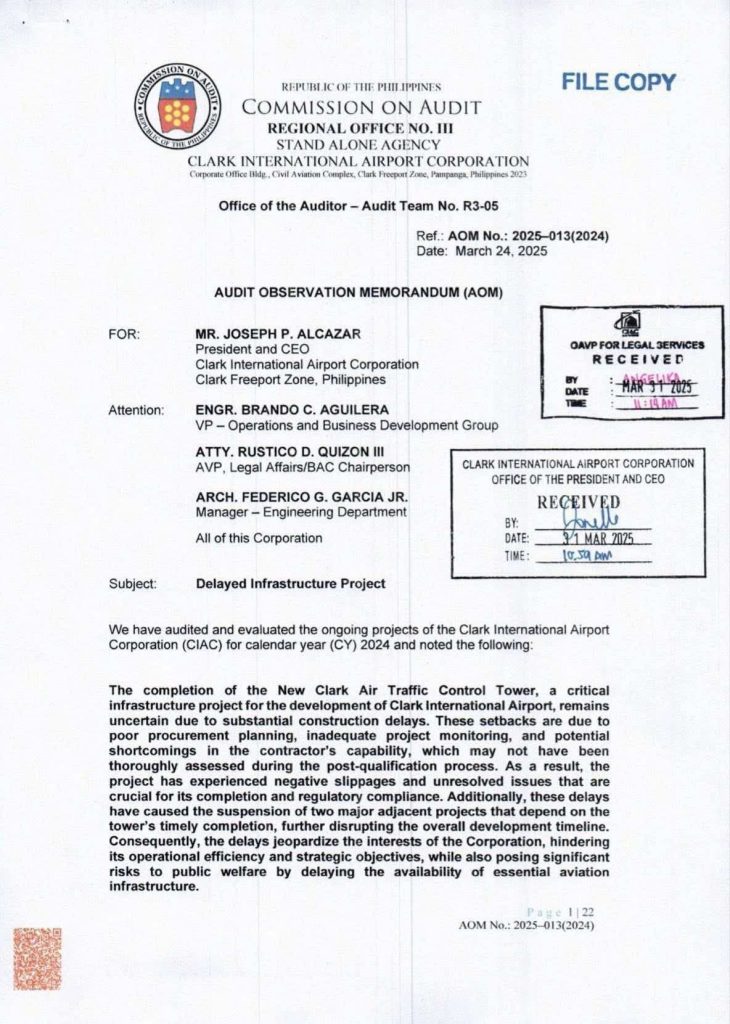
MANILA, Philippines – The Commission on Audit (COA) has flagged the Clark International Airport Corporation (CIAC) for disbursing millions of pesos in advance payments to a contractor despite incomplete or non-existent work on a key aviation infrastructure project.
In Audit Observation Memorandum (AOM) No. 2025-013, COA’s Region III office reported that CIAC certified and released payments totaling P5.47 million for portions of the “New 18-storey Clark Air Traffic Control Tower Facility” project even though these components had not been completed—or, in some cases, had not even started.
The project’s revised cost has ballooned to P354.4 million, far exceeding the original budget of P291 million.

Among the most glaring issues, according to state auditors, was a P3.2-million payment for elevator equipment that was supposedly delivered and 55% installed as of December 2023. But when auditors visited the site months later, they found only a completed shaft. The contractor’s site engineer later admitted that the elevator only arrived in late August 2024. No delivery receipt or invoice was submitted to support the earlier billing.
Another P2.27 million was paid for concrete works and reinforcements at the project’s carpark area. But COA said the site was being used as a dumping ground, with “no visible structural works.” The contractor admitted the area had not yet been prioritized.
Under the law and the project’s contract terms, payments must only be made for “physically completed and verified” work. COA warned that certifying incomplete accomplishments violates both procurement rules and financial accountability standards.
“While the observed overpayment of P5.47 million may be billable in the future, they constitute unjustified advance payments at the time they were made,” the report said.
What raised further red flags was that these premature billings passed through multiple levels of CIAC’s internal review—from the Project Management Office and Engineering Department to the office of the President and CEO.
“This reflects a systemic breakdown in internal controls,” COA said, warning that officials involved may face administrative, civil, or even criminal liability.
Elevator brand switch questioned
COA also discovered a major discrepancy in the elevator brand installed. The original contract called for an 18.1-million-peso German-made Schneider unit, but a Chinese-made Global Fuji elevator was installed instead.
The change, formalized through a variation order citing “technical incompatibility,” slashed costs by P12.3 million. However, auditors noted that the substitution lacked clear documentation of safety tests or technical validation.
During an inspection in March 2025, COA found that the elevator—advertised as having a 13-person capacity—could only hold seven people, raising safety concerns.
“Cost savings should not come at the expense of safety and compliance,” the report said.
The audit linked these irregularities to ongoing delays in completing the tower facility, a key component of Clark International Airport’s expansion.
COA urged CIAC to tighten billing protocols, strengthen oversight mechanisms, and hold accountable those who certified incomplete or unsupported claims.
“Advance payments for unaccomplished work distort financial reports, hide delays, and erode transparency,” COA concluded.